Showing posts with label Japanese culture. Show all posts

Monday, February 8, 2010

Shizukuishi

A friend of mine who lives in the neighbouring prefecture of Iwate asked me to organise a group of people to evaluate a doburoku tour that he wishes to offer as a service to tourists to the area. Doburoku (濁酒) is basically home make sake.

So on February 6th a group of 16 of us went to Shizukuishi. Some of us went up early and had time to visit the Snow Festival at Koiwai Farm, the largest private general farm in Japan. It was pretty impressive too. There were all sorts of snow sculptures.


This was a line of snow restaurants you could go into and have lunch!


We then went to Minshuku Nakagawa (民宿なかがわ) for our hands-on doburoku making experience! The owner Mr. Nakagawa everything he was doing in detail and my friends wife Miho translated for us. It seemed pretty easy. Steam rice, let it cool, add some stuff and keep it in a barrel with the temperature maintained between 10 and 20 degrees for about a week. After that you have a load of doburoku!

Before dinner started a few of us decided to go to an onsen. The closest one was Yukotan no Mori (ゆとかんの森). After showering and warming up in the inside bath, myself and Austin headed for the rotemburo (outside bath). We had to go out into the hall and down some stairs. I slipped going down the oddly shaped steps and bounced awkwardly and painfully down the last 3 or 4 steps. Embarrassed and bleeding I got up and tried to stop my elbow from bleeding. We continued into the onsen to meet the other 3 guys we were with and found that 2 of them had also slipped on the stairs! We compared injuries; my blood clinched the victory!

We headed back to the minshuku for a dinner of a huge variety of local mountain dishes. It was delicious. And we got to drink as much as we wanted, for 4 hours!


Then some of us put on our snowboarding gear and went outside for snow sumo!

The next morning after breakfast we realised first that one of the drivers had lost his car keys while playing snow sumo, and that another person had lost a camera. So we were all running around looking for keys and cameras, sifting through snow in all the places we remembered playing sumo - which turned out to have been many places! Eventually Austin randomly kicked a bank of snow on the side of the road, the one created by the snowploughs after clearing the roads, and the spot he kicked just so happened to be where the keys were buried in the snow! Lucky!!!

We finally left and headed to Shizukuishi Ski Resort for the day. It's a nice big ski jo with plenty of long runs, steep inclines, and plenty of black courses to enjoy!

Sunday, October 11, 2009

Kiritampo Party

The nurse at one of my schools is a member of LABO and every year they have a kiritampo party at Sanbouen (三望苑) in Honjo. I went last year for the first time, and she invited me again this year.

This year 6 of the local ALTs joined the party; Paul, Austin, Abby, Todd, Jimmy and myself. When we arrived the barbeques were were already cooking sweet potatoes. We were all handed beers and told to enjoy ourselves!

Kiritampo is mashed up rice that is moulded onto sticks and then cooked over a BBQ. We helped out mashing the rice and forming it onto the sticks.


We didn't get to help out with the cooking of them, but did get given more beer and various salads. And when the kiritampo was cooked we were served kiritampo nabe; a soup with various vegetables and of course the kiritampo.

After eating we went to the park area and set up two slacklines, a kind-of not-so-tight tightrope. Most of us are still learning how to balance/walk on the line. I can balance pretty well, until I try to take a step forward. Its a whole lot of fun though, and easier than you might imagine.


We got to see an amazing sunset just before we left too!

Thursday, October 1, 2009

Rice

Today I was at Shimokawa elementary school (下川小学校). During a free period before lunch the principal asked me if I wanted to join the 5th grade students harvesting rice. Every year the kids get the opportunity to plant a field of rice and then help harvest it.

I was delighted to get the opportunity to try it out!


A kamada or sickle (鎌田).


A small inekariki (稲刈り機) or rice combine harvester.


We stacked the rice at the edge of the field.


I spoke to a little old Japanese woman who was working there. She explained the entire rice reaping process to me. But unfortunately about 98% of what she said to me went right over my head. One thing I did pick up on though was that the field we were working in would have a yield of about 240 kilograms; about a years supply of rice for 7 or 8 people.

Sunday, September 20, 2009

Honjo Festival

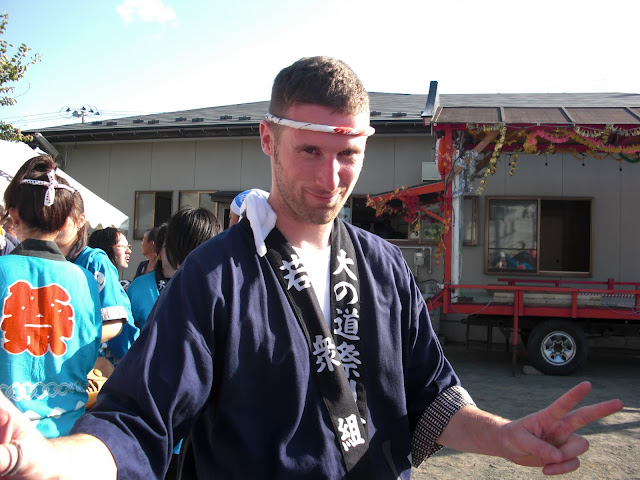
The two Japanese guys who were on our rowing team this year live in the same area as me in Honjo. They invited me and my friends to take part in the local Ōnomichi chōnai (大の道町内) festival on 20 September. We practiced twice at my local community centre (大の道公民館), which I just discovered existed!

We were practicing a simple enough beat on the taiko (太鼓). We needed to have 2 drummers at any given time, one rhythm and the other on main beat. There were also a group of fue (笛) players. And everyone shouts out the word sore (それ), multiple times!


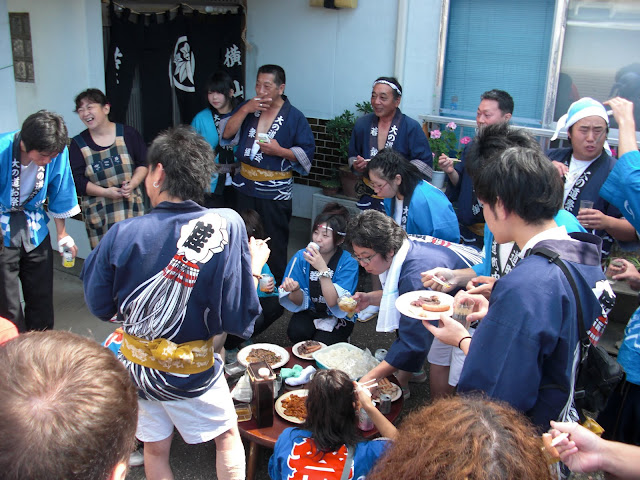
On our second night of practice, the day before the festival, we had plenty of free food and drinks given to us. We ate what has now become usual to us; yakitori, yakisoba and okonomiyaki. And we drank sake from square wooden cups!

And after a late night we got up and returned to the community centre for 8am the next morning for the opening ceremony of the festival. And it's customary to open any good ceremony with a shot of sake; so that was when our started drinking!

We were the first group to lead the drumming. Basically the group tours around the local area. People watch from the side of the street, and random people come out of their houses and give large bottles of sake to us! Some people even give out envelopes with money inside!


We made our first pit stop after about 15 minutes. We stopped outside a house and were ushered into an open garage. In the centre of the garage was a table with onigiris, pickled vegetables, miscellaneous meats and large bottles of beer and of course sake.


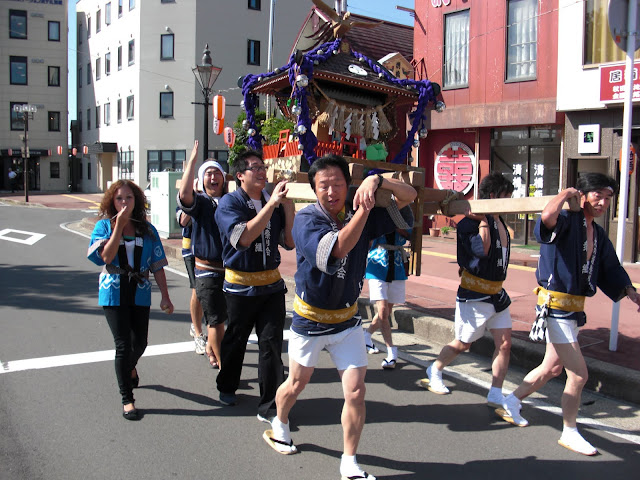
After indulging ourselves for about 15 to 20 minutes we were each given towels and told that we would be carrying the portable shrine, called a mikoshi (御輿, 神興 or 神輿) for a while. The towels were to pad our shoulders as the shrine was quite heavy.

When we picked it up and placed it on our shoulders it quickly became apparent that most of us foreigners were taller than the Japanese guys we were with. Some of the guys could not get their shoulders high enough to take any of the weight! Our chant also changed from sore to wasshoi (わっしょい).


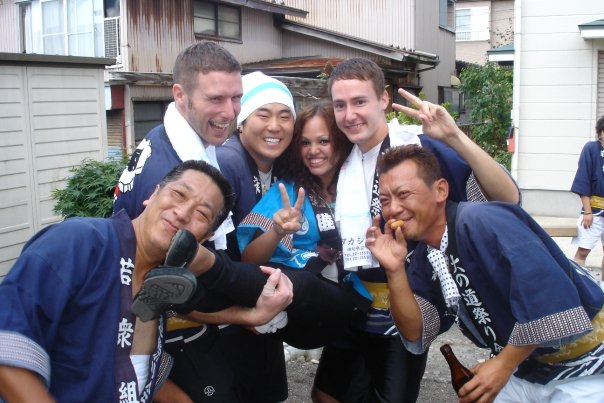
We continued carrying the shrine and chanting for the rest of the day. We made regular stops at houses around Honjo. Eating and drinking without fail at each stop! Some people were even slamming large glasses of sake at 10am!!


I can't actually remember what time the festival ended (probably 5 or 6pm), but when it did we went to Yumiko's house for sushi and alcoholic refreshments. And after about two hours there we headed back to Jez's apt for bit of a party there.

It was one of the most enjoyable days I have had since I arrived in Japan!

Wednesday, August 12, 2009

4 days, 4 festivals and a Mountain

The Shōbu Carnival (菖蒲カーニバル) is the first summer festival in Honjo every year. It's a small street festival where people of all ages dance to a single song, the Shōbu song I believe, played over and over again. And it draws huge local crowds every year. And there are lots of stalls selling festival food!

We went to the park to indulge in some yakisoba and beer and found that there was a band playing there. The band, Bronze, were an interesting bunch. They had bass, sax, drums and guitar/koto. Koto is a traditional Japanese instrument and usually played with the fingers and small small picks attached to your fingers. This band was using sticks to play it! I took this video.


The next day, 1st August, I met Akagawa-san to climb Mt. Gassan. He's a 56 year old guy I went hiking with last year, I think he's the head of a hiking group in Yokote city. Mt. Gassan (月山) is the highest of the three holy mountains in Dewa Sanzan, a 2 and a half hour drive south from where I live.

It was a little bit cloudy during our hike but pretty good conditions otherwise. The hike itself was not that difficult for me. But I was really surprised with the age of some people who were climbing it. There was definitely men and women over 70 years of age climbing it! And on the way up with found an old woman lying down, barely able to talk. She had decided to climb on her own, and obviously wasn't able for it. Some guys called the rescue crew to get her!

This is a statue that you can pray to for long life.


When we arrived at the summit we paid 500 yen to have a priest to say a prayer over us, and Akagawa-san was there to pray for his daughter to pass her entrance exam into high school.

We made good time coming down, and went for an onsen before we headed back home.

That sunburned evening I went to the second summer festival in Honjo, the Honjo Fireworks River Festival (本荘川まつり花火大会). Fireworks are really popular in Japan, and a lot more impressive than the shows we get at home.

The next day I headed to Amori prefecture to see the Nebuta Festival. It was a 4 hour drive north to Hirosaki where our hostel was, and then another train journey to Aomori city. Nebuta is a large scale lantern festival. Unfortunately when we were there it was lightly raining so all the floats had plastic sheets protecting them. It was very impressive none the less! In the picture you can see all the people under the float pushing it around.


The next day, Monday, we went to see rice field artistry! I had only discovered this place actually existed the week before. I had seen pictures on the Internet a long time ago but assumed that it was created using computers. The tambo art is in a place called Inakadate, close to Hirosaki city. You can climb up a castle and look down on the fields. It was really amazing!


They had a free outdoor foot onsen right beside the fields too, which was a nice little addition.

We then left Aomori and headed back to Akita city for my fourth festival in as many days, Kanto festival (竿燈まつり). This is a really cool festival where glowing lanternsin the shape of rice ears, are balanced on peoples hands, hips and heads (like the guy in this photo!).


This is a cool video I took at the end of the festival, when the guys really didn't care about damaging their lanterns!

Saturday, May 9, 2009

Golden Week

Golden Week in Japan is basically a few public holidays that run consecutively, and depending on their timing with a weekend can make a nice long holiday at the start of May. Last year I went to Hiroshima for these holidays. This year a group of us went to Hirosaki (弘前) and Lake Towada (十和田湖), both in Aomori prefecture just north of Akita.

On Saturday 2nd May 5 of us departed in two cars, Phil's and mine, bound for Hirosaki Park. And after about 3 or 4 hours we arrived in the park, with food, BBQ and copious amounts of drink. We found a nice spot under a sakura tree and did like the locals, have a laugh and get drunk!


A little disappointment came when we realised that there were no fire signs up all around the park. So we had to make do with snack foods for the night. But a fantastic sunset make everything right again.


The next day we headed for the famous Apple Park (りんご公園). Aomori is famous for it's apples, and it has apple flavour everything! I had apple ramen. It was quite different to a normal ramen, but nice for a change! And for dessert we had apple ice cream cones.

We then headed for the lake Towada. We first set up out tents at Oide Campground (生出キャンプ場) right beside the lake and headed to the small town for dinner and a look around. When we returned we found that somebody had decided our tents were not pitched very well, and had actually re-pitched one of them!!


We got some drinks and had our BBQ, finally. It rained lightly, but nothing like we had expected, thankfully.

The next day we were about to go to Oirase River, but we discovered that the other driver had lost his car keys! And after searching almost everywhere, including the communal camp bins, full with stinking meat trays, we failed in locating the keys. So we contacted another guy who we knew was planning on making the trip north and managed to convince him to backtrack to pick up a spare key.

In the meantime we all got into my car and headed for the very beautiful Oirase River. This is the river that drains Lake Towada and it has many waterfalls and a walkway along it for a nice few kilometres. Below is probably the most impressive waterfall along the way; Choshi Great Falls (銚子大滝).


After returning to the camp we met up with David, who had brought us the spare key. And after a further 30 minutes Phil found the original key - in his one man tent! We went to the Towada Prince Hotel onsen, which was quite close to our campground, and it had an amazing rotemburo!

We actually met a bunch of other people we knew at the same campground and drank together that night. While we were sitting around our campfire a random, incredibly drunk, Japanese guy appeared out of nowhere, sitting down beside us! He was pretty entertaining.


The next morning we packed up tents and headed for Shingō village (新郷村), to visit the Grave of Jesus (キリストの墓). I had actually been here before, and had no interest in returning, but the others did want to visit it. Have a read of the following information if you want to know the real truth about Jesus:


After our short visit there we headed to a place that requires even more imagination to believe, the ancient Ooishigami Pyramids (大石神ピラミッド). Apparently among the oldest pyramids, it's a little difficult to understand how these could ever have been pyramids. But apparently that is because of an earthquake that knocked one of the large boulders with all the inscriptions over, burying all the evidence. Zannen (残念) as they say in Japanese; too bad.


On the way home we all stopped at Yuritori Land onsen. The we separated into cars of people who wanted to go directly home and those that were in no rush, as it was starting to get late, considering it was about a 4 hour drive home from where we were. Just Sophie and I decided to take our time on the way home.

We stopped at a place called Oyu Stone Circle (大湯環状列石) in Kazuno city. We didn't really understand what exactly this place was. The information centre was closing as we arrived. But whatever it is, it was a lot more believable that our previous two stops.


Overall it was a fantastic few days. It's always nice to get away from the norm to awaken the sense perceptions, which quietens the mind!

Monday, April 13, 2009

Getting buried

Spring has finally arrived in Akita. All the snow is gone, the sun has arrived, heaters have been stowed away, and hats and scarves are no longer necessary when going to bed. Yesterday was the hottest day of the year, a little over 20°C, and I was able to wear a short sleeved t-shirt for the first time this year.

So to celebrate the fantastic weather I decided to go to a place called Wagagunyuda Town just inside Iwate prefecture, to visit the Sunayukko sand bath (砂ゆっこ). Hot, natural onsen water flows underneath the sand to heat it. After lying down in the shallow grave like hole, the workers there used shovels to bury all but my face in hot sand. They then wrote a number in the sand over my feet indicating what time I got buried at, presumably to avoid accidentally cooking me.

After 10 minutes the sweat was dripping down my face. A woman came over with a cold towel and mopped my face, and disappeared. Another 10 minutes passed and my friend, who had been buried 5 minutes after me asked to be dug out early. I was told my time was up and could get up; my friend was told that her time was not yet up and to stay another few minutes.


It was my first time to a sand bath, and definitely an enjoyable experience, though it was very hot in there. And the onsen that is available afterwards was probably one of the hottest onsens I have been to in Japan. But I felt fantastic afterwards! I was hoping to take my own photos while we were there but unfortunately that wasn't possible.

Wednesday, March 11, 2009

Sushi

This is a rather funny guide to correct Japanese etiquette in a Sushi restaurant. It’s a bit long, but it’s definitely worth watching!

Monday, March 9, 2009

Dewa Graduation

On March 8th I woke up no feeling the may west! But it was 7am and I had to get up for graduation day #2, Dewa junior high school, my main school.

I was assigned my seat in the teacher section in the gym, and was not too excited when I saw where it was. Sitting beside the brass band was good because I was surly not going to fall asleep for too long but sitting beside the horn player as not what any person with a hangover should have to endure! This picture was taken from my seat, and I had to lean back to take it!!


The ceremony was very similar to Ouchi's graduation; this was just bigger as there are more students. We had 53 graduating students, and one of the students I saw for the very first time! I asked my teacher about it though I didn't understand her answer. Apparently that student and 3 others that I had never met also graduated!


The weather was much better so the picture session outside was much more pleasant. Although I think there were far more criers today than yesterday. I took plenty of photos today.


I will miss many of these students. Two in particular, the ones who did the speech contest with me last September, both students actually really like English and were always happy to talk with me. Most students get excited when they see the ALT but all they usually ever say is "Hello".

Ouchi Graduation

On Saturday 7th March the 3rd grade students graduated from Ouchi junior high school. We all had to go to school as normal. The students and teachers had final preparations to make that morning, I had time to check my emails. Each student was presented with a picture book of all the teachers, students and various different events that happened throughout their time at the school. Some of the students came to me to get me to write a message in it. The ceremony started at 10am sharp and was held in the school gym. All students and most parents attended. The students had been rehearsing for this event for the past week or two.


The ceremony started with the brass band playing music as the 40 graduating students entered the room. Everyone applauded constantly as all the students entered the room. Once seated, everyone (bar me) sung the national anthem, the school song and one other song. The students had all trained to stand and sit down at exactly the same time, and it was quite impressive to see how in sync they all were.

A few speeches from a few random people I had never seen before were given. Then each student took turns going up onto the stage to get presented with their graduation certificate/book from the principal. Then the principal gave a speech at which point a few of the students were getting emotional. The class president then went up to make a speech. The sad music was turned on in the background as she delivered a 5 minute long speech. As she gave her speech I looked around at the students and saw many of them trying to contain the tears. Then I looked at the students who were not graduating, they were also crying. Then I looked at the parents of the graduating students and they seemed to be shedding as many tears as the rest!

The students here have a love for their school that can't be compared with the schools in Ireland, at very least not the school I attended. When I graduated everyone was delighted to be leaving the school. These students were deeply disappointed. Although their age is somewhat different, junior high school is the same as junior certificate level at home. They will go to another school for senior certificate level. We didn't have a graduation after junior certificate as we were not changing school.


After we applauded the last student back out of the gym, we had time to go to the staff room for a hot cup of green tea. The weather on Saturday was particularly bad; very windy, bitterly cold and it was starting to snow again.


Next up the students were departing the school for the last time. We put on our jackets and headed outside to see a short outdoor ceremony. The children were all taking photos of each other and giving each other gifts. I took some photos with my favourite students.


Later we went to a party for the parents in Hotel Iris. That kicked off at 5pm and there was a dinner and an all-you-can-drink for two and a half hours. It started off slow but as people started to get drunk I had many people coming to talk with me. Last year I had a parent get insulted with me because I didn't know her child by name, so this year I came prepared with a sheet with all the students faces and names so that I'd know who was who!

After that part finished we moved on to the second party at Blue Shuttle, a karaoke bar with another 2 hour all-you-can-drink. I was speaking with the parents of the class president and my other favourite student for a long time. One of them wanted me to sing a traditional Irish song on the karaoke. I told him if there was one there I would, as long as he did too. Of course I knew here wasn't going to be a traditional Irish song, but he sang the national anthem anyway! After that party ended they tried to get me to go to a third party, yet another all-you-can-drink bar, but it was close to midnight and I knew I had to be up bright and early the next day for the graduation at Dewa junior high school, my other school.

Tuesday, February 24, 2009

YouTube

I recently took a video clip of an interesting looking chair in a love hotel. I posted it on YouTube 5 days ago and was surprised to see how many views it was getting!


Yesterday I realised that it is currently the 10th most viewed video in Ireland this month and the 12th most viewed in Japan this week in the education section of YouTube!

Monday, February 16, 2009

Balloon Festival


On 10th of February every year there is a Balloon Festival in Kamihinokinai, Nishiki, Semboku City, Akita. Huge hot air paper balloons are released. They were between 8 to 12 metres in height and about 3 metres in diameter. The balloons are first filled with hot air from gas hoses, and then a ball of material soaked in fuel is attached and ignited. The balloons can travel for kilometres or crash nearby. I don't know if they collect the balloons afterwards, to be honest I don't see how they could!


There are two festivals on the same date every year, and they are a little apart, the other festival being the Giant Tug of war in Kariwano, Daisen City. We decided to try to make it the two festivals. But the Balloon Festival was further away than we thought. We still tried to make the Tug of war, but arrived just as it ended.


We stayed at the Balloon festival for only about 30 minutes, but it was really impressive. These are some of the video clips we took while there.

Wednesday, February 11, 2009

Maths

While studying Japanese last week I came across the word for multiplication table, 九九 (kuku) which translates into nine nine. I thought it a little strange at the time but didn't think too much about it.

Yesterday I was asked to join the 3rd grade maths class as my JTE was absent because her sick was child. My role was to go to the class and read out equations the teacher wrote on the board such as 2x + 4x = 6x and (a + b)² = a² + 2ab + b². The students were unfamiliar with how to read such equations. The goal was just to expose them to words like: multiplied by, divided by, squared, cubed, equals etc.

It was my first time attending a full class other than English since I started teaching here. An interesting thing came up. In Japan students learn the multiplication tables only up to 9 x 9, (hence the name) as opposed to 12 x 12 in Ireland and most western countries. The math teacher told me that in India the students learn up to 17 x 17!

At the end of class the teacher the asked the students to give Mr. Owen a 'challenge' question. So one smart-ass kid stands up after flicking through his maths book to find the most difficult equation he could find and reads out this:

√40 + 5√2 / √5 = ?
Read: the square root of 40 plus the 5th root of 2 divided by the square root of 5 equals ...

Yeah, you win this round kid!

Shamisen New Year Party

On Sunday 8th February 2009 we had a New Year's party with my shamisen group. We were to meet at 9am, somewhere, but as usual I couldn't understand my teacher, so after collecting everyone at the pick-up point he got the bus to meet me at Honjo city hall. We then went to Kisakata Seaside Hotel, about 30 minutes south of Honjo.

We went to the same place last year also, though at the time I had no idea that it was a New Year's party, I just though it was a concert. I also found out this year that the group I play with is much bigger than I though, it has about 25 members and is called Akita shinzankai (秋田新山会). In the folk group we have shamisen, shakuhachi, and taiko players, as well as dancers and singers.


To start off the day we had a meeting about the groups finances. Then we got changed into our kimonos and hakamas, went into a room with a stage set up and took some group photos. I realised how much taller I was to everyone else! Then we began our concert.

Everyone took turns playing different songs and dancing. The age of these people is quite apparent. I reckon the youngest, besides myself, is about 50 and she is much younger than the rest which must all have about 40 years on me!


I played just one song this year, ringo bushi. I played it with my teacher, a taiko drummer, shakuhachi player and a singer. I took a video but unfortunately the singer was standing between me and the camera for most of the video.


We started our enkai, which involves much drinking, at about 1 o'clock. Beer was the first drink to arrive, and was followed quickly by wine and whiskey both of which i refused, at first. Then came tamagozake (卵酒) or egg sake, not something I reccommend, though apparently it is good for the common cold! Then the normal sake arrived, then the wine came back. At this point many of my collegues were getting drunk quickly and becomming more insistant that I should drink everythink they had to offer!

At 4pm we headed back to Honjo and went to a karaoke bar, owned by the wife of my teacher called Night in Castle. They were singing all Japanese folk songs, many dating from the 1940's! When they requested me to sing I knew I was in trouble. I looked for my only reliable song, the one all my friends must be sick of hearing, 1979, but apparently it was a much too recent song. I went with the slightly older Disarm. Nobody joined in!

Thursday, January 29, 2009

The Cove

The Cove is a new documentary film that I have been awaiting the release of for a long time now. It's about the slaughter of dolphins and porpoises in Japan and the high level of mercury in the oceans which bio-accumulates in the fish that we consume regularly.


The film-makers went undercover in a small town called Taiji in Wakayama prefecture, south of Osaka, to document the slaughter. The dolphin drive, which happens every year, involves fishermen herding about 2,300 mammals into a secluded cove, which is hidden from public view, and slaughtering them. The slaughter methods used are far from humane, stabbing and spearing them, it often takes a few hours for them to die. Most Japanese people are unaware of this practice.

The Cove, produced by the Ocean Preservation Society, was nominated at the 2009 Sundance Film Festival and won the Audience Award.


The cove, an intelligent/action/adventure/Oceans's Eleven-like horror film wrapped around a tale of redemption and revenge - oh and it's a documentary.

I still haven't got a release date for the film, but I'm really hoping it won't be much longer.

For those of you interested in this subject, there is an excellent article on the Japan Times website.

Friday, January 9, 2009

Kakizome

Yesterday my Board of Education had kakizome (書き初め), a tradition done at the start of each year. Kakizome means First Calligraphy of the New Year. I joined the elementary school group and tried out my shuji (習字) skills, as I did this time last year as well. Last year I was given 2nd grade kanji to try (白いはと, shiroi hato - White dove), yesterday I was given 5th grade kanji (希望の春, kibou no haru - Spring hope). It was quite an increase for me as I still haven't mastered the 1st grade kanji.


Here are my 6 attempts; my first attempt is on the right and last on the left. My 2nd last effort was chosen as the best.


My study group...


A guy who actually knows what he's doing...


Our finest work!

Wednesday, November 5, 2008

Ringo Bushi

This is my shamisen teacher, Kuroki sensei, playing ringo bushi (りんご節). This is the latest song he is teaching me. This song is an Aomori song; ringo means apple, bushi means song. Aomori is the most northern prefecture in Honshū, and it is famous for apple orchards.

Wednesday, October 8, 2008

Zazen

During my first visit to Japan in 2005, I visited a zendo in Hiroshima to try zazen for my first time. I enjoyed it, even though it was quite difficult. At the time, I only got the chance to go to that zendo once. Last weekend I got to go to Chokai-san International zendo (鳥海山国際禅堂), in Yashima, for my second encounter with zazen. The zendo is only about 40 minutes drive from my apt, so I really don't know why I hadn't gone sooner!

We arrived just in time to share dinner with the zazen master, Sato-san and his wife Mariko. Both these people are among the nicest you could meet. Sato-san is a peaceful, jolly man, and Mariko the caring mother type. Both also had a satisfying level of English for easy communication.


After dinner we had a rest period before the meditation was to begin. I took the time to read an English version of the instructions to refresh what I had learned in Hiroshima. Emphasis is put on how you walk in the Zendo, when and where to bow, and how you sit during the meditation, the latter being the most difficult by far. You are provided with a round cushion to sit on. The correct way to sit is to have 3 main points of contact with the ground; your butt, and both knees. Obviously having your ass touch the ground is not a problem, but having both knees is! If you can sit in the full lotus position, this will not be an issue. I, unfortunately, struggle with even the half lotus position.

So while trying to tie my legs into knots – while remaining silent! – I remembered that while in Hiroshima I had the same problem, and was given two cushions before I could get both knees to touch the ground. But... the teacher had left at this stage, so I was going to have to soldier on with just the one. I managed as best I could with two points of contact, with the other right knee refusing to touch the ground, with what resembled magnetic repulsion!


While meditating, you face a wall and are instructed to keep your eyes slightly open while looking down at a 45º angle, while not focusing on any particular point. And just concentrate on savoring every breath. The objective is to quieten the mind. But this is a very difficult thing to do. In fact, in this quite environment, the mind seems to work overtime. Thinking of everything and anything; a thought from earlier in the day, a feeling from last week, or a forgotten memory from 15 years ago!

And while the memories are flooding your mind, your legs encourage you not to forget about them. They do this in a number of ways, first are uncomfortable, then they tingle, then they throb. And your back is sore because the muscles are not used to supporting your back so straight. So it slowly curls down and down until you finally realise, and try to correct it, but each time you do correct it, you can't straighten it as much as the last time, and eventually you just give up altogether. Meanwhile you eyes have become heavy because of the relaxation, and the fact you are in a dimly lit room is not helping matters. And all this time your mind is constantly trying to guess how long you have been in this awkward position, and more importantly, how much longer you must endure it. You knew when you started that it was going to be a 30 min session, so you have been trying to keep track of the time, not an easy thing to do. Your logical mind says maybe 20 minutes, while your evil mind flashes up a clock showing only 7 minutes have past.

Finally the bell rings. And it's the sweetest sounding bell you have ever heard! You release your legs and then can fully appreciate how much pain you were actually in. And after you lift your dead legs with your hands and direct them towards the sandals you wore when walked in, the pins-and-needles party starts! You struggle to your feet, still remaining silent of course, and follow the master in a slow and mediating walk around the zendo and out. At which point your legs are back to normal, and for some reason you feel peaceful and very proud of what you just accomplished.


That night I slept on the same place as we had mediated, and dreamt dreams that were nowhere as peaceful as I had felt before going to bed. We awoke the next morning to the sound of the bell, that no longer sounded sweet, at 5:30 in the morning. We had another meditation session at 6am. I managed to get 3 points of contact for most of the session. After having breakfast with Sato-san, he left us saying he had some work to do. He told us to stay as long as we liked, just requesting we close the doors as we left. We decided to go for one more session before departing.

I do like zazen. I think once I become more competent at sitting in the correct position it will become much more enjoyable. I have practiced a few times at home since then, and am finding the sitting easier, though I'm not quite able for the full lotus position just yet. I hope to return to the zendo again soon.